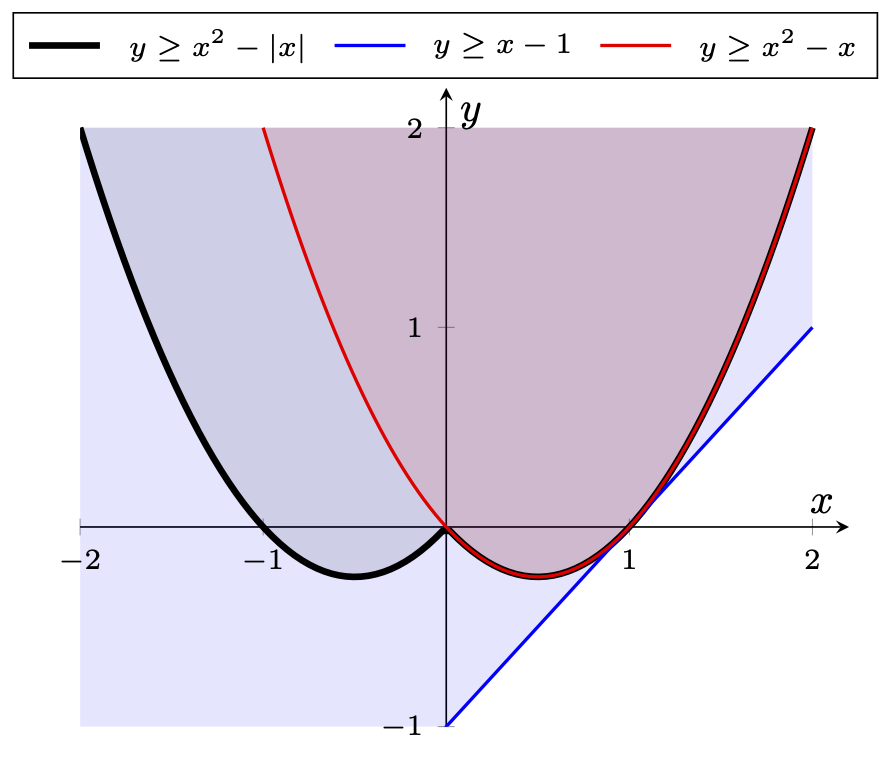
We introduce a quadratically-constrained approximation (QCAC) of the AC optimal power flow (AC-OPF) problem. Unlike existing approximations like the DC-OPF, our model does not rely on typical assumptions such as high reactance-to-resistance ratio, near-nominal voltage magnitudes, or small angle differences, and preserves the structural sparsity of the original AC power flow equations, making it suitable for decentralized power systems optimization problems. To achieve this, we reformulate the AC-OPF problem as a quadratically constrained quadratic program. The nonconvex terms are expressed as differences of convex functions, which are then convexified around a base point derived from a warm start of the nodal voltages. If this linearization results in a non-empty constraint set, the convexified constraints form an inner convex approximation. Our experimental results, based on Power Grid Library instances of up to 30,000 buses, demonstrate the effectiveness of the QCAC approximation with respect to other well-documented conic relaxations and a Taylor-series linear approximation. We further showcase its potential advantages over the well-documented second-order conic relaxation of the power flow equations in the optimal reactive power dispatch and photovoltaic hosting capacity problem.
@article{Constante-Flores2026,author={{Constante Flores}, Gonzalo E. and Li, Can},doi={10.1007/S11081-026-10079-4},issn={1573-2924},journal={Optimization and Engineering},keywords={Control,Engineering,Environmental Management,Financial Engineering,Operations Research/Decision Theory,Optimization,Systems Theory,general},pages={1-23},publisher={Springer},title={A quadratically-constrained convex approximation for the AC optimal power flow},url={https://link.springer.com/article/10.1007/s11081-026-10079-4},year={2026},}
IEEE TSG
Physics-Based Reinforcement Learning Framework for Energy Management of Airport Thermo-Electrical Microgrids
Pablo Verdugo-Rivadeneira, Mehrdad Pirnia, Claudio A. Cañizares, and 1 more author
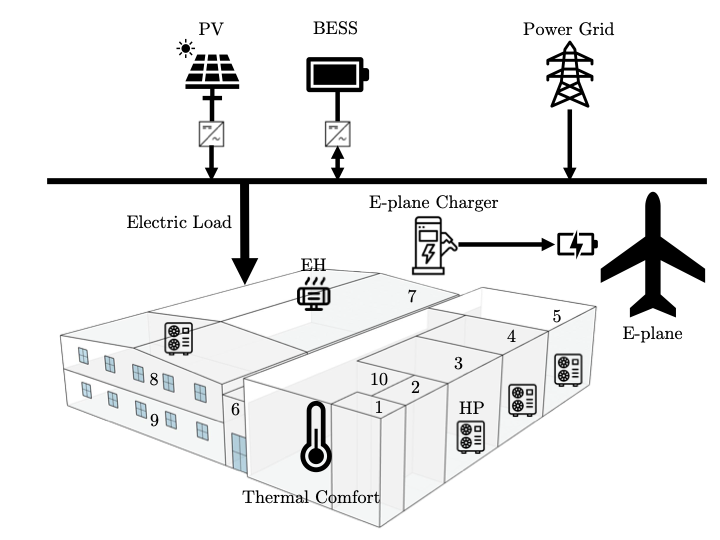
With the adoption of electric planes to achieve aviation Net-Zero goals, the implementation of proper Energy Management Systems that can satisfy both the electric and thermal needs of airport buildings is paramount. However, the design of Energy Management Systems for thermo-electrical microgrids is challenging, particularly for model-based approaches, due to the complexities associated with detailed component modeling, uncertainties in renewable generation, and environmental conditions. Thus, this paper proposes a model-free Reinforcement Learning framework for the optimal operation of multi-zone airport hangar microgrids ensuring constraint satisfaction by incorporating physics-based dynamic constraints, and an implicit method to properly represent heat exchanges between zones. Simulation results, based on the operation of an actual Canadian airport microgrid with e-plane charging are benchmarked against a classical optimization-based approach, demonstrating that the proposed method achieves near optimal results. Furthermore, compared to conventional reward based approaches, the proposed framework is shown to have significantly faster convergence and more stable training behavior.
@article{VerdugoRivadeneira2026,title={Physics-Based Reinforcement Learning Framework for Energy Management of Airport Thermo-Electrical Microgrids},author={Verdugo-Rivadeneira, Pablo and Pirnia, Mehrdad and Ca{\~n}izares, Claudio A. and Constante Flores, Gonzalo E.},journal={IEEE Transactions on Smart Grid},year={2026},}
2025
INFORMS JDS
OptiChat: Bridging Optimization Models and Practitioners with Large Language Models
Hao Chen, Gonzalo E. Constante Flores, Krishna Sri Ipsit Mantri, and 3 more authors
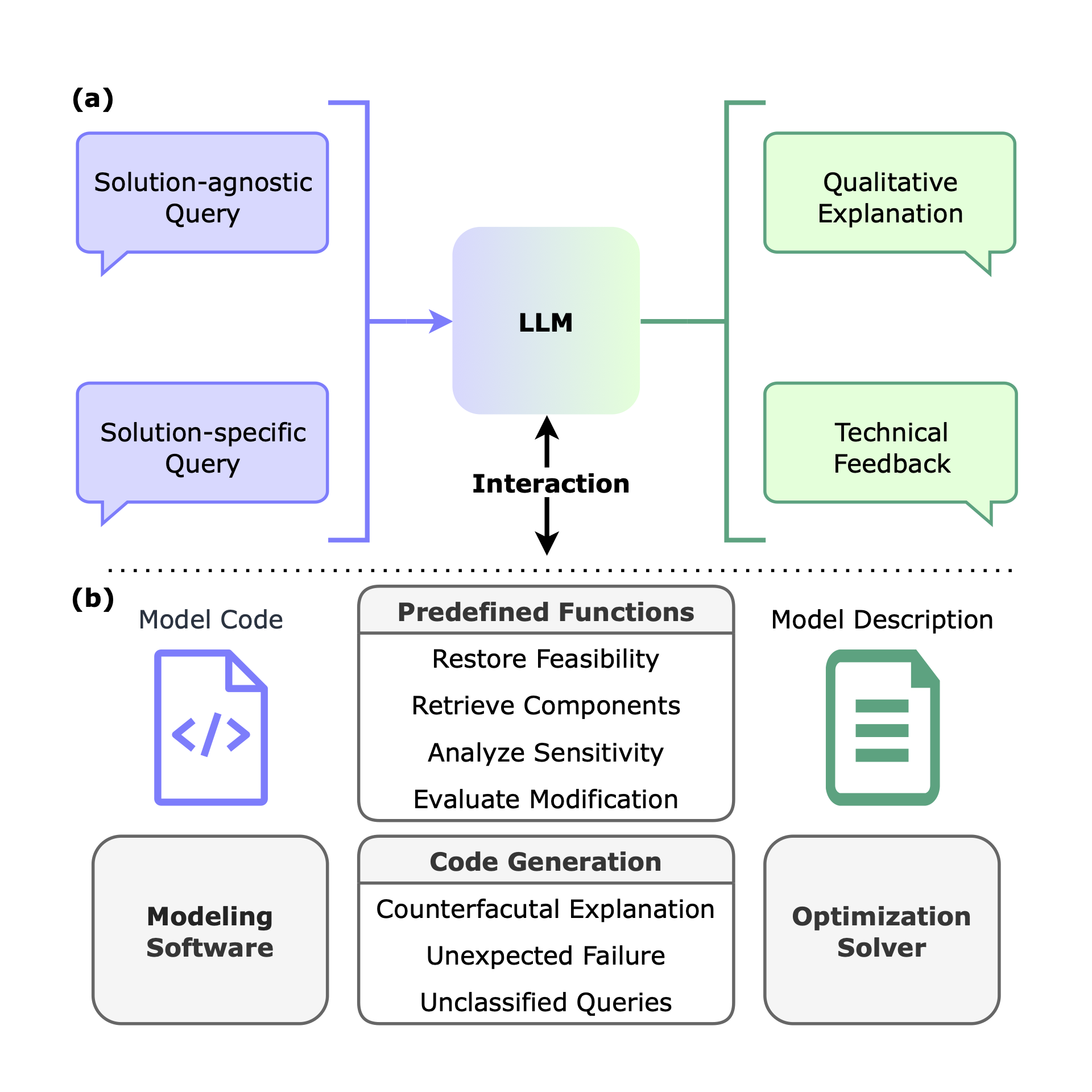
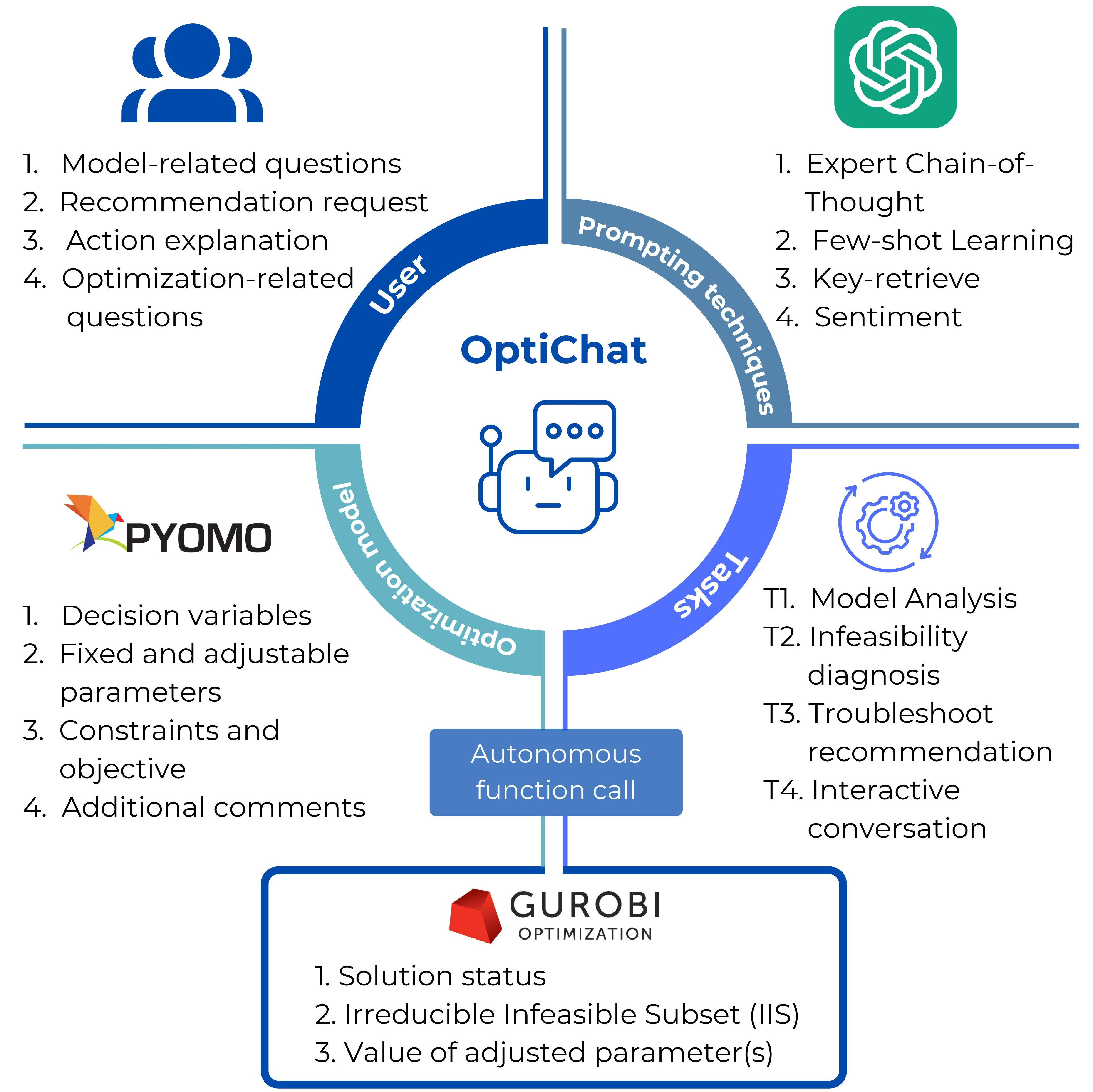
Optimization models have been applied to solve a wide variety of decision-making problems. These models are usually developed by optimization experts but are used by practitioners without optimization expertise in various application domains. As a result, practitioners often struggle to interact with and draw useful conclusions from optimization models independently. To fill this gap, we introduce OptiChat, a natural language dialogue system designed to help practitioners interpret model formulation, diagnose infeasibility, analyze sensitivity, retrieve information, evaluate modifications, and provide counterfactual explanations. By augmenting large language models (LLMs) with functional calls and code generation tailored for optimization models, we enable seamless interaction and minimize the risk of hallucinations in OptiChat. We develop a new data set to evaluate OptiChat’s performance in explaining optimization models. Experiments demonstrate that OptiChat effectively delivers autonomous, accurate, and instant responses. These findings highlight the potential of LLMs to bridge the gap between optimization models and practitioners in the real-world decision-making process.
@article{Chen2025,author={Chen, Hao and {Constante Flores}, Gonzalo E. and Mantri, Krishna Sri Ipsit and Kompalli, Sai Madhukiran and Ahluwalia, Akshdeep Singh and Li, Can},doi={10.1287/ijds.2025.0074},issn={2694-4022},journal={INFORMS Journal on Data Science},title={OptiChat: Bridging Optimization Models and Practitioners with Large Language Models},year={2025},}
HICSS
AC-Network-Informed DC Optimal Power Flow for Electricity Markets
Gonzalo E. Constante Flores, André Quisaguano, Antonio J. Conejo, and 1 more author
In Proceedings of the 58th Hawaii International Conference on System Sciences (HICSS), 2025
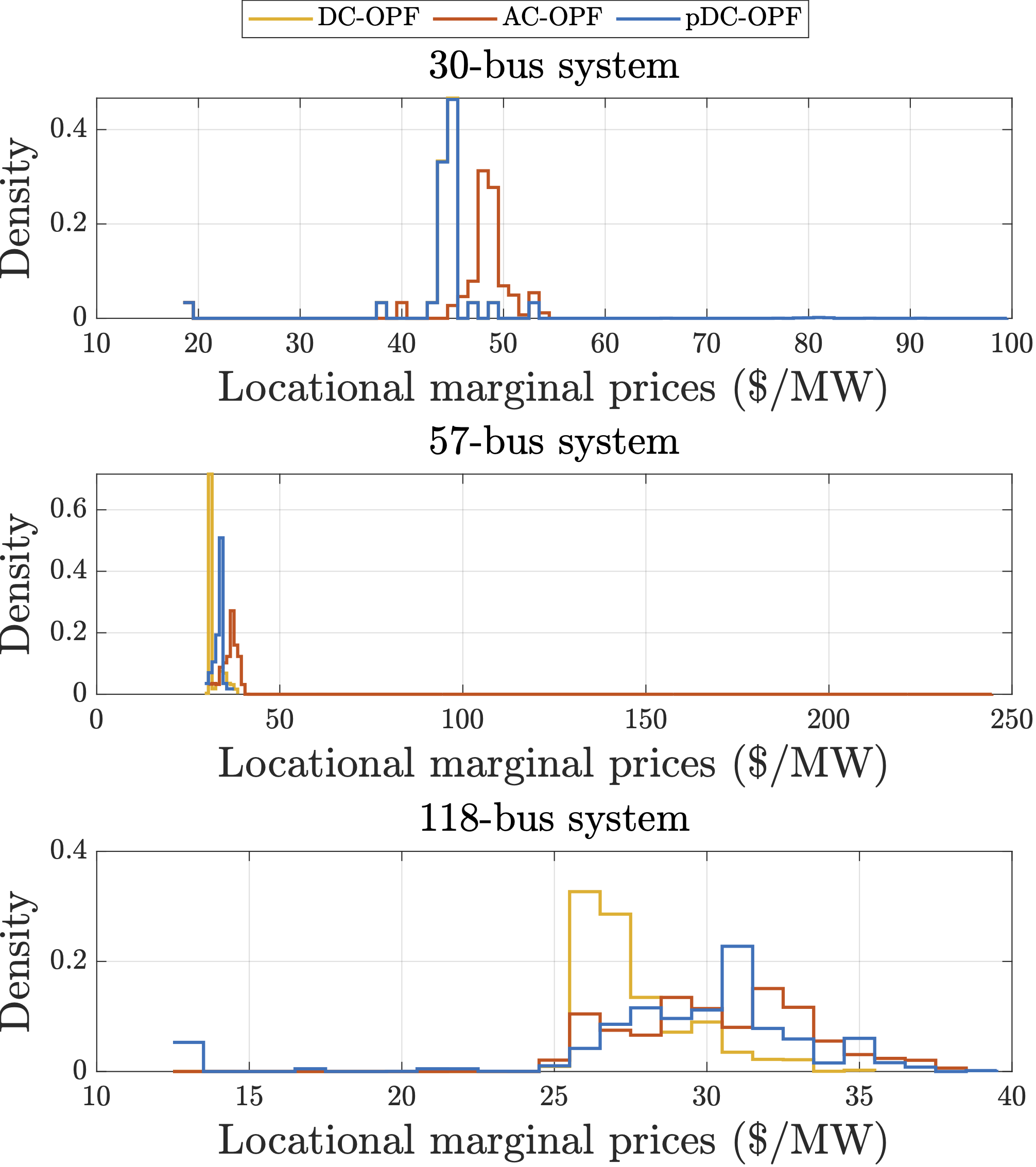
This paper presents a parametric quadratic approximation of the AC optimal power flow (AC-OPF) problem for time-sensitive and market-based applications. The parametric approximation preserves the physics-based but simple representation provided by the DC-OPF model and leverages market and physics information encoded in the data-driven demand-dependent parameters. To enable the deployment of the proposed model for real-time applications, we propose a supervised learning approach to predict near-optimal parameters, given a certain metric concerning the dispatch quantities and locational marginal prices (LMPs). The training dataset is generated based on the solution of the accurate AC-OPF problem and a bilevel optimization problem, which calibrates parameters satisfying two market properties: cost recovery and revenue adequacy. We show the proposed approach’s performance in various test systems in terms of cost and dispatch approximation errors, LMPs, market properties satisfaction, dispatch feasibility, and generalizability with respect to N-1 network topologies.
@inproceedings{Constante2025,author={{Constante Flores}, Gonzalo E. and Quisaguano, André and Conejo, Antonio J. and Li, Can},booktitle={Proceedings of the 58th Hawaii International Conference on System Sciences (HICSS)},doi={10.24251/HICSS.2025.367},pages={1--10},title={AC-Network-Informed DC Optimal Power Flow for Electricity Markets},year={2025},}
NeurIPS
Enforcing Hard Linear Constraints in Deep Learning Models with Decision Rules
Gonzalo E. Constante Flores, Hao Chen, and Can Li
In Advances in Neural Information Processing Systems, 2025
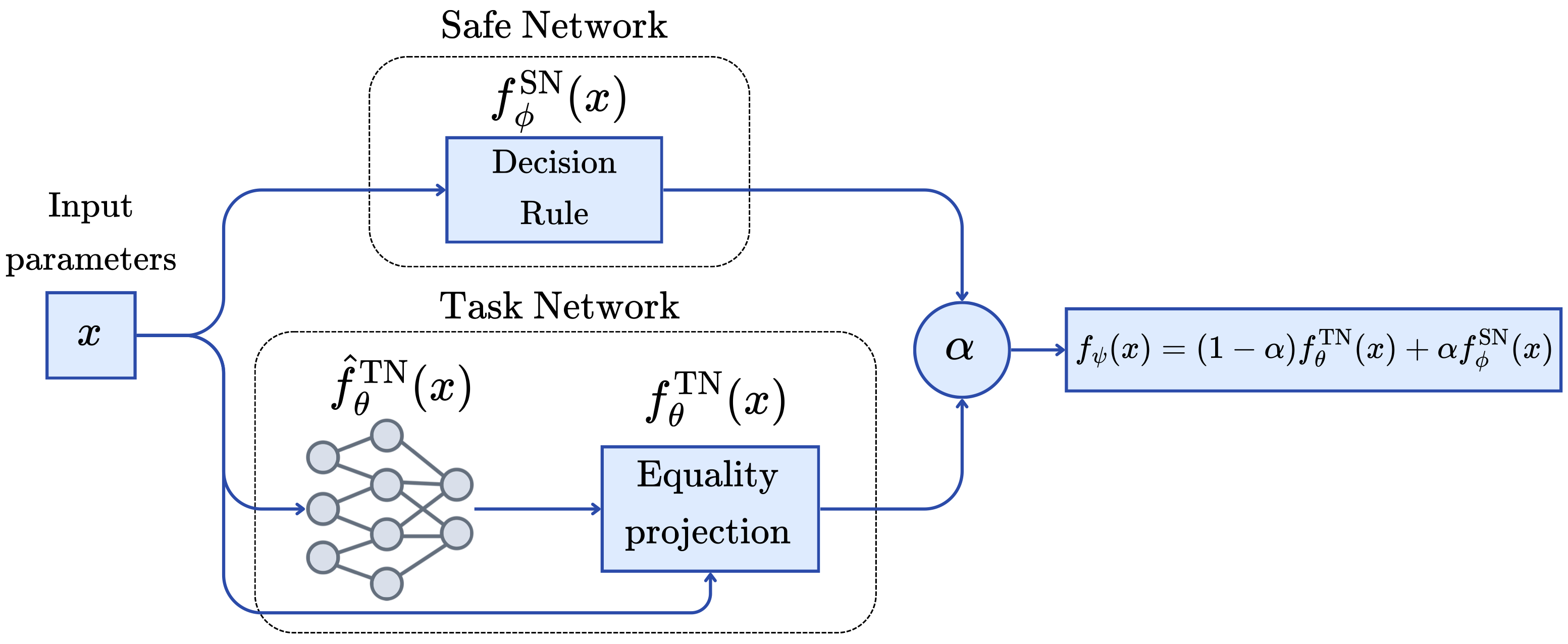
Deep learning models are increasingly deployed in safety-critical tasks where predictions must satisfy hard constraints, such as physical laws, fairness requirements, or safety limits. However, standard architectures lack built-in mechanisms to enforce such constraints, and existing approaches based on regularization or projection are often limited to simple constraints, computationally expensive, or lack feasibility guarantees. This paper proposes a model-agnostic framework for enforcing input-dependent linear equality and inequality constraints on neural network outputs. The architecture combines a task network trained for prediction accuracy with a safe network trained using decision rules from the stochastic and robust optimization literature to ensure feasibility across the entire input space. The final prediction is a convex combination of the two subnetworks, guaranteeing constraint satisfaction during both training and inference without iterative procedures or runtime optimization. We prove that the architecture is a universal approximator of constrained functions and derive computationally tractable formulations based on linear decision rules. Empirical results on benchmark regression tasks show that our method consistently satisfies constraints while maintaining competitive accuracy and low inference latency.
@inproceedings{Constante2025enforcing,author={{Constante Flores}, Gonzalo E. and Chen, Hao and Li, Can},booktitle={Advances in Neural Information Processing Systems},doi={10.52202/085713-3510},pages={116408--116433},title={Enforcing Hard Linear Constraints in Deep Learning Models with Decision Rules},url={https://papers.neurips.cc/paper_files/paper/2025/hash/975a1a8e86e72c148aa2152243953064-Abstract-Conference.html},volume={38},year={2025},}
Neural Netw.
Conformalized prediction of post-fault voltage trajectories using pre-trained and finetuned attention-driven neural operators
Amirhossein Mollaali, Gabriel Zufferey, Gonzalo Constante-Flores, and 4 more authors
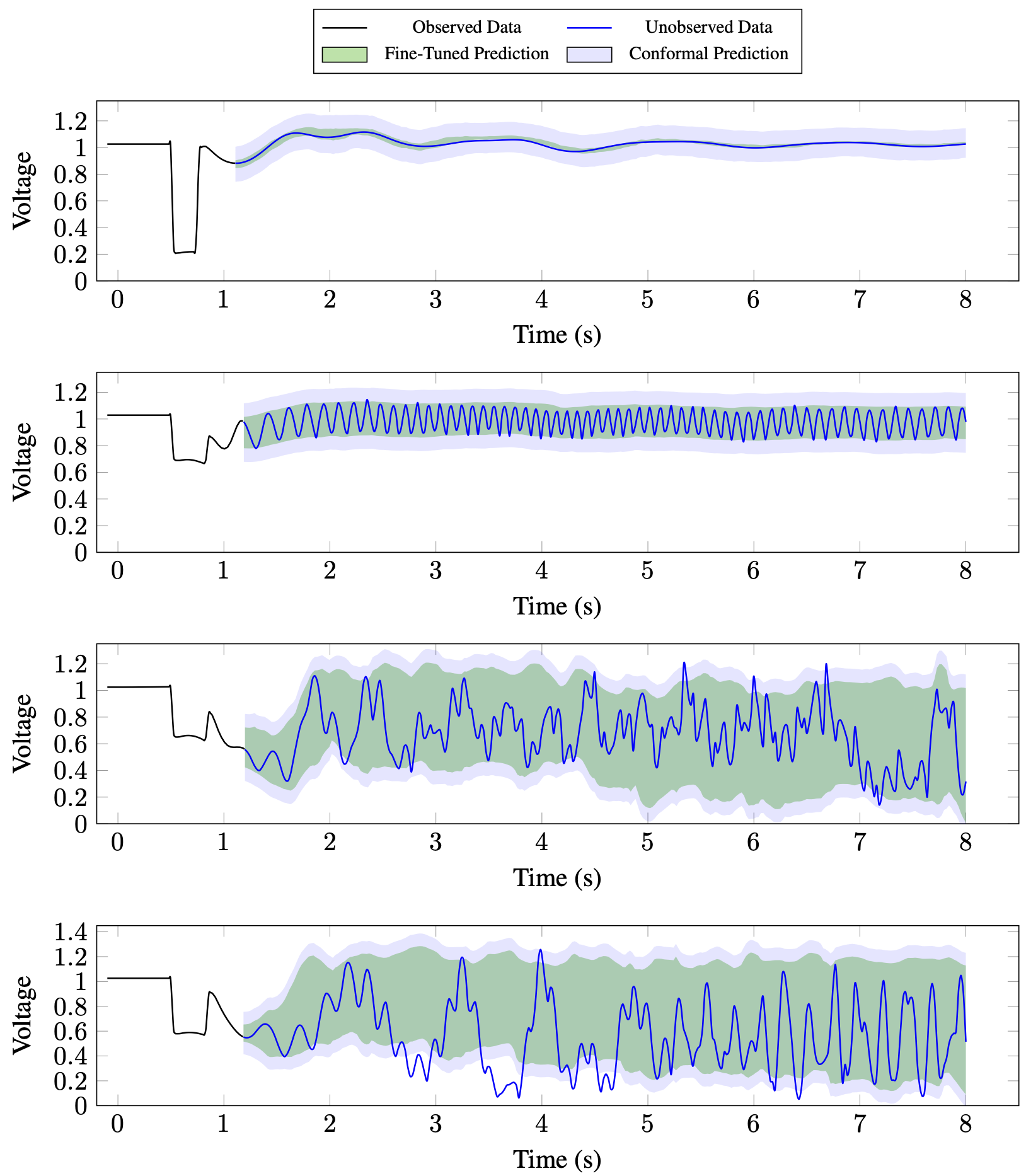
This paper proposes a new data-driven methodology for predicting intervals of post-fault voltage trajectories in power systems. We begin by introducing the Quantile Attention-Fourier Deep Operator Network (QAF-DeepONet), designed to capture the complex dynamics of voltage trajectories and reliably estimate quantiles of the target trajectory without any distributional assumptions. The proposed operator regression model maps the observed portion of the voltage trajectory to its unobserved post-fault trajectory. Our methodology employs a pre-training and fine-tuning process to address the challenge of limited data availability. To ensure data privacy in learning the pre-trained model, we employ federated learning to aggregate information from neighboring buses, enabling the model to learn the underlying voltage dynamics from such buses without directly sharing their data. After pre-training, we fine-tune the model with data from the target bus, allowing it to adapt to unique dynamics and operating conditions. Finally, we integrate conformal prediction into the fine-tuned model to ensure coverage guarantees for the predicted intervals. We evaluated the performance of the proposed methodology using the New England 39-bus test system, considering detailed models of voltage and frequency controllers. Two metrics, Prediction Interval Coverage Probability (PICP) and Prediction Interval Normalized Average Width (PINAW), are used to numerically assess the model’s performance in predicting intervals. The results show that the proposed approach offers practical and reliable uncertainty quantification in predicting the interval of post-fault voltage trajectories.
@article{Mollaali2025,author={Mollaali, Amirhossein and Zufferey, Gabriel and Constante-Flores, Gonzalo and Moya, Christian and Li, Can and Yue, Meng and Lin, Guang},doi={10.1016/J.NEUNET.2025.107809},issn={0893-6080},journal={Neural Networks},keywords={Conformalized prediction,Deep Operator Networks,Fine-tuning,Power grid dynamics,Uncertainty quantification,Voltage stability},month=dec,pages={107809},publisher={Pergamon},title={Conformalized prediction of post-fault voltage trajectories using pre-trained and finetuned attention-driven neural operators},volume={192},url={https://www-sciencedirect-com.colorado.idm.oclc.org/science/article/abs/pii/S0893608025006896},year={2025},}
2024
INFOR
Diagnosing infeasible optimization problems using large language models
Hao Chen, Gonzalo E. Constante Flores, and Can Li
INFOR: Information Systems and Operational Research, 2024
Decision-making problems can be represented as mathematical optimization models, finding wide applications in fields such as economics, engineering, transportation, and healthcare. One of the primary barriers to deploying these models in practice is the challenge of helping practitioners understand and interpret such models, particularly when they are infeasible, meaning no decision satisfies all the constraints. Existing methods for diagnosing infeasible optimization models often rely on expert systems, necessitating significant background knowledge in optimization. In this paper, we introduce OptiChat, a first-of-its-kind natural language-based system equipped with a chatbot GUI for engaging in interactive conversations about infeasible optimization models. OptiChat can provide natural language descriptions of the optimization model itself, identify potential sources of infeasibility, and offer suggestions to make the model feasible. The implementation of OptiChat is built on GPT-4, which interfaces with an optimization solver to identify the minimal subset of constraints that render the entire optimization problem infeasible, known as the Irreducible Infeasible Subset (IIS). We utilize few-shot learning, expert chain-of-thought, key-retrieve, and sentiment prompts to enhance OptiChat’s reliability. Our experiments demonstrate that OptiChat assists both expert and non-expert users in improving their understanding of the optimization models, enabling them to quickly identify the sources of infeasibility.
@article{Chen2024,author={Chen, Hao and {Constante Flores}, Gonzalo E. and Li, Can},doi={10.1080/03155986.2024.2385189},issn={0315-5986},journal={INFOR: Information Systems and Operational Research},pages={1-15},title={Diagnosing infeasible optimization problems using large language models},year={2024},}
C&CE
Physics-informed neural networks with hard linear equality constraints
@article{Chen2024b,author={Chen, Hao and {Constante Flores}, Gonzalo E. and Li, Can},doi={10.1016/j.compchemeng.2024.108764},journal={Computers & Chemical Engineering},pages={108764},title={Physics-informed neural networks with hard linear equality constraints},volume={189},year={2024},}
EJOR
Daily scheduling of generating units with natural-gas market constraints
Gonzalo E. Constante Flores, Antonio J. Conejo, and Feng Qiu
@article{Constante2024,author={{Constante Flores}, Gonzalo E. and Conejo, Antonio J. and Qiu, Feng},doi={10.1016/j.ejor.2023.08.024},issue={1},journal={European Journal of Operational Research},pages={387-399},title={Daily scheduling of generating units with natural-gas market constraints},volume={313},year={2024},}
EJCO
An effective hybrid decomposition approach to solve the network-constrained stochastic unit commitment problem in large-scale power systems
Ricardo M. Lima, Gonzalo E. Constante Flores, Antonio J. Conejo, and 1 more author
@article{Lima2024,author={Lima, Ricardo M. and {Constante Flores}, Gonzalo E. and Conejo, Antonio J. and Knio, Omar M.},doi={10.1016/j.ejco.2024.100085},journal={EURO Journal on Computational Optimization},pages={100085},title={An effective hybrid decomposition approach to solve the network-constrained stochastic unit commitment problem in large-scale power systems},volume={12},year={2024},}
2023
IJEPES
Stochastic scheduling of generating units with weekly energy storage: A hybrid decomposition approach
Gonzalo E. Constante Flores, Antonio J. Conejo, and Ricardo M. Lima
International Journal of Electrical Power & Energy Systems, 2023
@article{Constante2023a,author={{Constante Flores}, Gonzalo E. and Conejo, Antonio J. and Lima, Ricardo M.},doi={10.1016/J.IJEPES.2022.108613},journal={International Journal of Electrical Power & Energy Systems},pages={108613},publisher={Elsevier},title={Stochastic scheduling of generating units with weekly energy storage: A hybrid decomposition approach},volume={145},year={2023},}
EJOR
Security-constrained unit commitment: A decomposition approach embodying Kron reduction
@article{Constante2023b,author={{Constante Flores}, Gonzalo E. and Conejo, Antonio J.},doi={10.1016/J.EJOR.2023.06.013},issn={0377-2217},journal={European Journal of Operational Research},keywords={Decomposition algorithm,Large scale optimization,Network reduction,OR in energy,Unit commitment},publisher={North-Holland},title={Security-constrained unit commitment: A decomposition approach embodying Kron reduction},year={2023},}
CS/RER
Stochastic Unit Commitment: Model Reduction via Learning
Xuan Liu, Antonio J. Conejo, and Gonzalo E. Constante Flores
Current Sustainable/Renewable Energy Reports, 2023
@article{Liu2023,author={Liu, Xuan and Conejo, Antonio J. and {Constante Flores}, Gonzalo E.},doi={10.1007/s40518-023-00209-2},issue={2},journal={Current Sustainable/Renewable Energy Reports},pages={36-44},title={Stochastic Unit Commitment: Model Reduction via Learning},volume={10},year={2023},}
AIChE J.
Distributed manufacturing for electrified chemical processes in a microgrid
Asha Ramanujam, Gonzalo E. Constante‐Flores, and Can Li
@article{Ramanujam2023,author={Ramanujam, Asha and Constante‐Flores, Gonzalo E. and Li, Can},doi={10.1002/aic.18265},journal={AIChE Journal},title={Distributed manufacturing for electrified chemical processes in a microgrid},year={2023}}
2022
IEEE TPWRS
AC Network-Constrained Unit Commitment via Relaxation and Decomposition
Gonzalo E. Constante Flores, Antonio J. Conejo, and Feng Qiu
@article{Constante2021a,author={{Constante Flores}, Gonzalo E. and Conejo, Antonio J. and Qiu, Feng},doi={10.1109/TPWRS.2021.3120180},issn={0885-8950},issue={3},journal={IEEE Transactions on Power Systems},pages={2187-2196},title={AC Network-Constrained Unit Commitment via Relaxation and Decomposition},volume={37},year={2022},}
IJEPES
AC network-constrained unit commitment via conic relaxation and convex programming
Gonzalo E. Constante Flores, Antonio J. Conejo, and Feng Qiu
International Journal of Electrical Power & Energy Systems, 2022
@article{Constante2022a,author={{Constante Flores}, Gonzalo E. and Conejo, Antonio J. and Qiu, Feng},doi={10.1016/J.IJEPES.2021.107364},journal={International Journal of Electrical Power & Energy Systems},keywords={Conic relaxation,Convex programming,Unit commitment},pages={107364},publisher={Elsevier},title={AC network-constrained unit commitment via conic relaxation and convex programming},volume={134},year={2022},}
EPSR
Stealthy monitoring-control attacks to disrupt power system operations
Gonzalo E. Constante Flores, Antonio J. Conejo, and Jiankang Wang
@article{Constante2022b,author={{Constante Flores}, Gonzalo E. and Conejo, Antonio J. and Wang, Jiankang},doi={10.1016/J.EPSR.2021.107636},journal={Electric Power Systems Research},pages={107636},publisher={Elsevier},title={Stealthy monitoring-control attacks to disrupt power system operations},volume={203},year={2022},}
TOP
Solving certain complementarity problems in power markets via convex programming
Gonzalo E. Constante Flores, Antonio J. Conejo, and Santiago G. Constante-Flores
@article{Constante2022c,author={{Constante Flores}, Gonzalo E. and Conejo, Antonio J. and Constante-Flores, Santiago G.},doi={10.1007/S11750-022-00627-3},issue={3},journal={TOP},pages={465-491},publisher={Institute for Ionics},title={Solving certain complementarity problems in power markets via convex programming},volume={30},year={2022},}
2021
MPCE
Sensitivity-based Vulnerability Assessment of State Estimation
Gonzalo E. Constante Flores, Antonio J. Conejo, and Jiankang Wang
Journal of Modern Power Systems and Clean Energy, 2021
@article{Constante2020,author={{Constante Flores}, Gonzalo E. and Conejo, Antonio J. and Wang, Jiankang},doi={10.35833/MPCE.2020.000658},issue={4},journal={Journal of Modern Power Systems and Clean Energy},pages={886-896},title={Sensitivity-based Vulnerability Assessment of State Estimation},volume={9},year={2021},}
2020
Proc. IEEE
Operations and Long-Term Expansion Planning of Natural-Gas and Power Systems: A Market Perspective
Antonio J. Conejo, Sheng Chen, and Gonzalo E. Constante
@article{Conejo2020,author={Conejo, Antonio J. and Chen, Sheng and Constante, Gonzalo E.},doi={10.1109/JPROC.2020.3005284},issn={0018-9219},issue={9},journal={Proceedings of the IEEE},pages={1541-1557},title={Operations and Long-Term Expansion Planning of Natural-Gas and Power Systems: A Market Perspective},volume={108},year={2020},}
2019
IEEE TIA
Data-Driven Probabilistic Power Flow Analysis for a Distribution System With Renewable Energy Sources Using Monte Carlo Simulation
Gonzalo E. Constante Flores and Mahesh S. Illindala
@article{Constante2019a,author={{Constante Flores}, Gonzalo E. and Illindala, Mahesh S.},doi={10.1109/TIA.2018.2867332},issn={0093-9994},issue={1},journal={IEEE Transactions on Industry Applications},pages={174-181},title={Data-Driven Probabilistic Power Flow Analysis for a Distribution System With Renewable Energy Sources Using Monte Carlo Simulation},volume={55},year={2019},}
IET GTD
Conservation voltage reduction of networked microgrids
Gonzalo E. Constante Flores, Joseph Abillama, Mahesh Illindala, and 1 more author
IET Generation, Transmission and Distribution, 2019
@article{Constante2019b,author={{Constante Flores}, Gonzalo E. and Abillama, Joseph and Illindala, Mahesh and Wang, Jiankang},doi={10.1049/iet-gtd.2018.5750},issue={11},journal={IET Generation, Transmission and Distribution},title={Conservation voltage reduction of networked microgrids},volume={13},year={2019},}